The premise
The Fürstenfeldbruck district is more than a line on an administrative map. Between the rivers Amper and the lake Ammersee lie 23 towns and parishes whose customs, civic associations and countryside speak a language of their own. This film listens before it tells.
Across the course of a day we follow two families: the Sinners — at home in town — and the Weiß family, rooted in the country. Their daily lives become the narrative bracket for a quiet, unhurried passage through the themes that hold the district together.
A short documentary in the manner of a visual essay — precise in its images, restrained in its words, clear in its position.
Stations of a journey
The film moves between administration and farmland, hospital and cloister, schoolroom and recycling yard, memorial and leisure park. Each station is its own image; each sequence its own thought.
- District Office: An early-morning opening, a welcome from the Landrat, a drone descent.
- Public transport: The S-Bahn platform, commuters moving between town and country.
- School & education: Tulpenfeld school complex; the pen glides across paper.
- Hospital: Care around the clock, an academic teaching hospital of LMU Munich.
- Fürstenfeld Monastery: A cultural anchor, bells, a place that holds a region together.
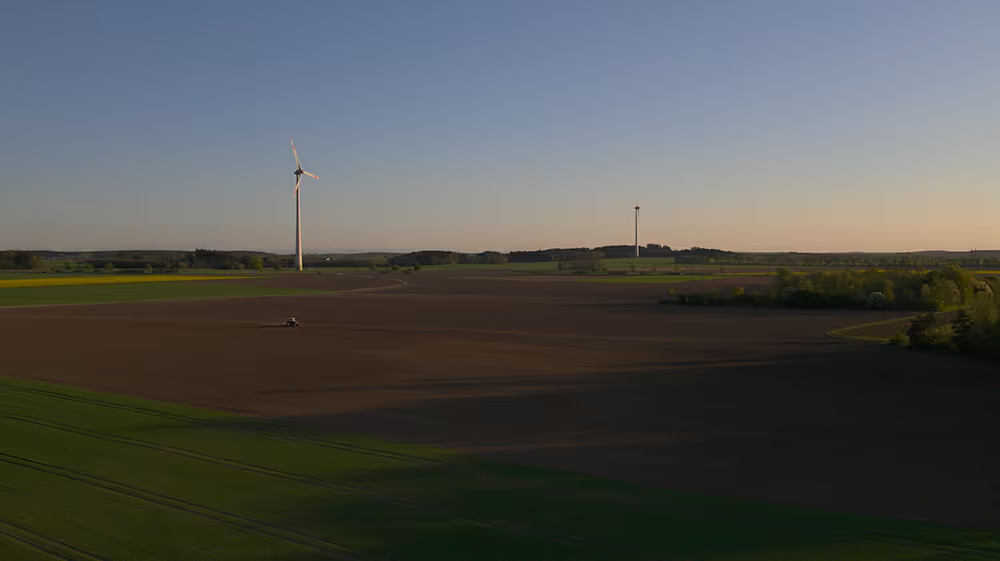
- Fields & Jexhof: Farming in the rhythm of nature; the past held up as a mirror.
- 1972 Memorial: Quiet remembrance, a stone, a soft click, respect.
- Recycling yard & GfA: Circular economy as a civic principle.
- Mammendorf Leisure Park: Water, laughter, the moment the two families meet.
- FLEXlinie: A last, gentle coda — mobility around the clock.
These stations form the arc. What the images themselves say remains here unsaid — they are made to be seen, not paraphrased.
Thematic threads
Eight themes carry the film. They are not didactically imposed; they emerge from the images themselves.
- Education: Spaces for learning and for what comes next; schools across the district.
- Healthcare: Hospital, nursing, the steady presence of medical care.
- Mobility: S-Bahn, bus, FLEXlinie — the threads between town and country.
- Culture: Monastery, Jexhof, the calendar of public events.
- Nature: Farming, the teaching gardens, the Amper landscape.
- Volunteering: Fire brigades, BRK, THW, Malteser, Johanniter, the citizens’ foundation, the food banks.
- Remembrance: The memorial to the 1972 Munich Olympics attack.
- Circular economy: The recycling yard, GfA — what is set aside is made anew.
Together these threads compose the portrait of a district that holds tradition and modernity in moving balance.
Colour-leading system
A deliberate cinematic choice: the film works with a colour system that separates the narrative layers visually and at the same time draws them together.
- Purple: Overarching, neutral images — the District Office, the voice-over.
- Orange: Town life — the Sinner family, school, hospital, culture.
- Green: Country life — the Weiß family, farming, nature.
- Blue: Encounter — both families together, the leisure park, shared moments.
The colours are not an effect. They are a quiet narrative tool — they order without dividing.
Production structure
For seasonal reasons the film is realised in two phases. Both follow the same dramaturgy — the second extends the visual world without replacing narrative elements.
- Phase A — Winter cut: Weather-independent, interior or winter-suitable motifs. A self-contained, presentation-ready interim film for delegations and events.
- Phase B — Summer cut: Season-bound motifs (nature, vegetation, leisure, agriculture). Integrated into the existing structure for the final cut.
The detailed shoot log, with date, place and current state of every session, is held in the protected area of this page.